
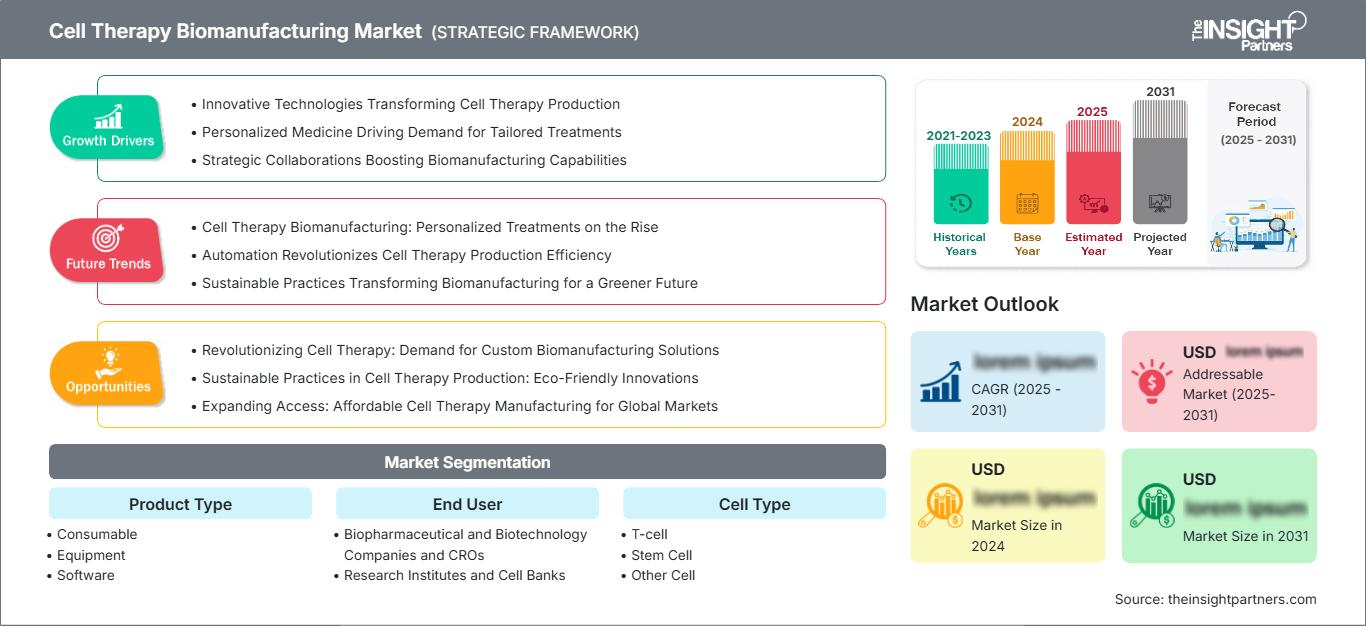
According to The Insight Partners, Global Cell Therapy Biomanufacturing Market is rapidly emerging as one of the most transformative segments within the global biopharmaceutical industry. The growing shift toward personalized medicine, increasing prevalence of chronic diseases, and breakthroughs in regenerative medicine are collectively driving strong demand for scalable and efficient cell therapy production. Cell therapy biomanufacturing involves the large-scale production, processing, storage, and distribution of living cells used in therapeutic applications such as cancer treatment, autoimmune disorders, and rare genetic diseases.
As the clinical pipeline for cell-based therapies continues to expand, manufacturers are investing heavily in advanced production platforms, automation, and regulatory-compliant facilities. The market is witnessing significant technological innovations that aim to reduce production costs, improve scalability, and ensure consistent product quality.
Get a Sample PDF – https://www.theinsightpartners.com/sample/TIPRE00028574
The growing commercialization of CAR-T therapies and stem cell-based treatments is particularly fueling the need for robust biomanufacturing infrastructure worldwide.
Market Overview
Cell therapy biomanufacturing has evolved from small-scale research operations to highly sophisticated industrial production processes. With numerous therapies moving from clinical trials to commercialization, the demand for standardized manufacturing processes has increased dramatically. Pharmaceutical and biotechnology companies are focusing on optimizing supply chains, improving cold-chain logistics, and enhancing regulatory compliance to support global distribution.
The expansion of contract development and manufacturing organizations (CDMOs) is also reshaping the market landscape. Outsourcing manufacturing operations enables therapy developers to reduce capital expenditure and accelerate time-to-market.
Key Market Drivers
- Rising Adoption of Cell and Gene Therapies
One of the strongest drivers of the cell therapy biomanufacturing market is the rapid increase in approved cell and gene therapies. These therapies provide new treatment options for previously untreatable diseases, including:
- Hematologic cancers
- Neurological disorders
- Cardiovascular diseases
- Rare genetic conditions
The success of CAR-T cell therapies has validated the commercial viability of cell-based treatments. As more therapies progress through late-stage clinical trials, the demand for commercial-scale biomanufacturing capabilities continues to grow.
- Increasing Investments in Regenerative Medicine
Governments and private investors worldwide are significantly increasing funding for regenerative medicine research. Public–private partnerships, academic collaborations, and venture capital investments are accelerating innovation in cell therapy development.
These investments are directly impacting biomanufacturing by:
- Supporting construction of advanced GMP manufacturing facilities
- Funding development of automated and closed-system platforms
- Accelerating process development and optimization
- Technological Advancements in Bioprocessing
Technological innovation is transforming cell therapy manufacturing from manual, labor-intensive processes into automated and scalable production systems. Key technological drivers include:
- Closed and automated manufacturing platforms
- Single-use bioreactors
- AI-driven process monitoring
- Advanced cryopreservation and cold chain solutions
Automation reduces contamination risk, improves reproducibility, and lowers operational costs—making therapies more accessible and commercially viable.
- Growing Demand for Personalized Medicine
Cell therapies are at the forefront of personalized medicine. Autologous therapies, which use a patient’s own cells, require highly specialized and individualized manufacturing workflows.
This shift toward patient-specific treatments is driving:
- Decentralized manufacturing models
- Point-of-care production facilities
- Advanced logistics and supply chain management
- Expansion of Contract Manufacturing Organizations
The increasing complexity of cell therapy production has led many developers to outsource manufacturing to specialized CDMOs. These organizations provide:
- Process development expertise
- GMP manufacturing capabilities
- Regulatory support
- Scalability for commercialization
The CDMO model enables biotech companies to focus on research and clinical development while reducing operational risks.
- Supportive Regulatory Environment
Regulatory agencies are introducing accelerated approval pathways and updated guidelines to support innovative therapies. Programs such as fast-track approvals and orphan drug designations are encouraging rapid development and commercialization.
Regulatory support is also promoting standardization and quality control across manufacturing processes, strengthening industry confidence and investment.
Emerging Trends in the Market
Shift Toward Allogeneic Therapies
While autologous therapies dominate the current landscape, allogeneic cell therapies are gaining traction due to their scalability and cost advantages. These “off-the-shelf” therapies can be manufactured in bulk, reducing production costs and improving accessibility.
Adoption of Modular Manufacturing Facilities
Modular and flexible manufacturing facilities are becoming increasingly popular. These facilities offer:
- Rapid deployment
- Reduced capital expenditure
- Scalability for future demand
Integration of Artificial Intelligence and Digitalization
AI and digital tools are being integrated into manufacturing processes to enhance:
- Quality control
- Process optimization
- Predictive maintenance
- Real-time monitoring
Digital transformation is expected to play a crucial role in improving production efficiency and regulatory compliance.
Market Challenges
Despite strong growth drivers, the industry faces several challenges:
- High manufacturing costs
- Complex supply chain logistics
- Skilled workforce shortages
- Strict regulatory requirements
- Scalability limitations for autologous therapies
Addressing these challenges will require continued innovation, collaboration, and investment.
Competitive Landscape – Top Market Players
The market is highly competitive, with leading biopharmaceutical companies and technology providers investing heavily in advanced manufacturing capabilities. Key players include:
- Thermo Fisher Scientific
- Merck KGaA
- Sartorius AG
- Lonza Group
- Danaher Corporation
- Cytiva
- FUJIFILM Holdings Corporation
- Catalent Inc.
These companies are focusing on strategic collaborations, acquisitions, and capacity expansions to strengthen their market position.
Regional Analysis
North America
North America dominates the cell therapy biomanufacturing market due to:
- Strong presence of biopharmaceutical companies
- Advanced healthcare infrastructure
- High R&D investments
- Supportive regulatory framework
The United States remains the global hub for cell therapy innovation and commercialization.
Europe
Europe is experiencing steady growth driven by:
- Government funding for regenerative medicine
- Expanding manufacturing facilities
- Growing clinical trial activity
Countries such as Germany, the UK, and Switzerland are leading regional adoption.
Asia Pacific
Asia Pacific is expected to witness the fastest growth due to:
- Increasing healthcare investments
- Rapid expansion of biotech startups
- Rising clinical research activity
- Cost-effective manufacturing capabilities
China, Japan, and South Korea are emerging as major cell therapy manufacturing hubs.
Get Premium Research Report Market Size and Growth Report at: https://www.theinsightpartners.com/buy/TIPRE00028574
Future Outlook
By 2031, the cell therapy biomanufacturing market is expected to experience significant expansion as more therapies transition from clinical trials to commercial availability. Key growth opportunities include:
- Development of universal donor cell lines
- Advanced automation technologies
- Expansion of decentralized manufacturing
- Increasing collaboration between academia and industry
The long-term outlook remains highly positive, with cell therapy poised to revolutionize modern medicine.
About Us
The Insight Partners is a one-stop industry research provider of actionable intelligence. We help our clients in getting solutions to their research requirements through our syndicated and consulting research services. We specialize in industries such as Semiconductor and Electronics, Aerospace and Defense, Automotive and Transportation, Biotechnology, Healthcare IT, Manufacturing and Construction, Medical Device, Technology, Media and Telecommunications, Chemicals and Materials.
Contact Us
Ankit Mathur
The Insight Partners
Email: ankit.mathur@theinsightpartners.com
Phone: +1-646-491-9876
Also Available in : Korean | German | Japanese | French | Chinese | Italian | Spanish