
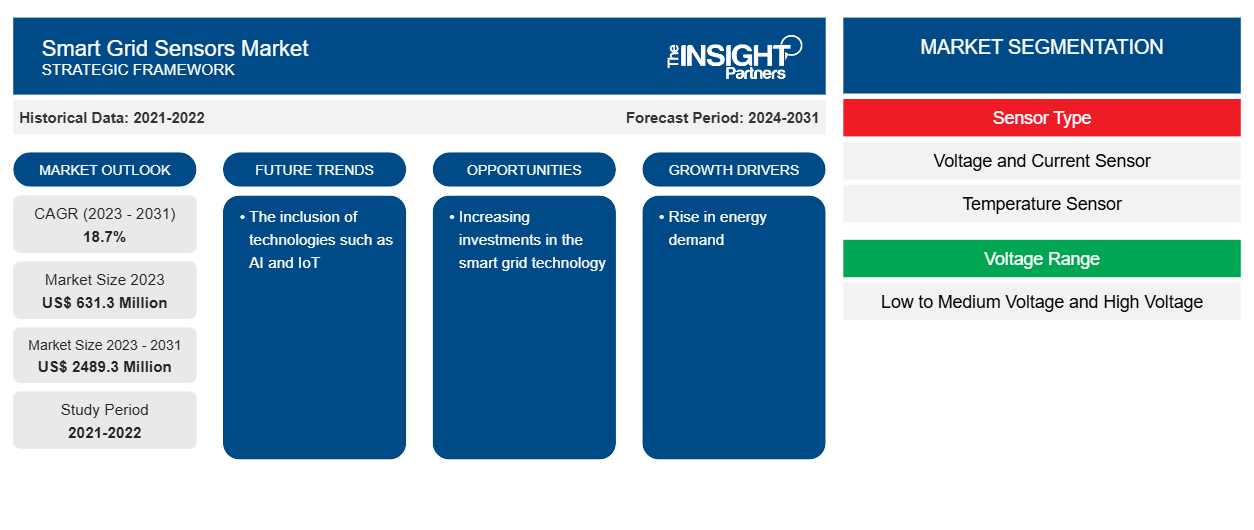
The smart grid sensors industry is witnessing rapid growth as utilities and energy providers increasingly modernize power infrastructure with intelligent monitoring and automation technologies. Smart grid sensors are advanced devices used to monitor voltage, current, temperature, fault conditions, power quality, and grid performance in real time across electrical transmission and distribution networks.
The increasing focus on energy efficiency, renewable energy integration, and grid reliability is significantly driving demand for smart grid sensors worldwide. Governments and utility companies are increasingly investing in smart grid technologies to improve operational visibility, reduce energy losses, and strengthen electricity network resilience.
Market Overview
The global Smart Grid Sensors Market was valued at US$ 631.3 million in 2023 and is projected to reach US$ 2489.3 million by 2031, registering a strong CAGR of 18.7% during the forecast period 2023–2031. Market growth is primarily driven by advancements in the energy and power sector, increasing deployment of smart grid infrastructure, and rising government investments in intelligent energy systems.
Smart grid sensors are increasingly being integrated into substations, smart meters, renewable energy systems, transmission lines, and utility monitoring networks to enable real-time grid analytics and automated fault detection. Advancements in IoT-enabled monitoring systems, AI-powered analytics, and cloud-based energy management platforms are further accelerating market expansion globally.
Key Market Insights
-
Market Size (2023): US$ 631.3 million
-
Forecast Market Size (2031): US$ 2489.3 million
-
CAGR (2023–2031): 18.7%
-
Key Growth Driver: Rising investments in smart grid modernization projects
-
Major Trend: Increasing integration of IoT and AI-based energy monitoring systems
-
Forecast Period: 2023–2031
-
Leading Region: North America
-
Fastest Growing Region: Asia-Pacific
Get a Sample PDF of the Report: https://www.theinsightpartners.com/sample/TIPRE00012739
Market Analysis
The Smart Grid Sensors Market is experiencing substantial growth due to increasing global demand for intelligent energy infrastructure and advanced power monitoring technologies. Utilities are increasingly deploying smart grid sensors to improve grid reliability, reduce outages, and support efficient energy distribution across modern electricity networks.
The rapid expansion of renewable energy infrastructure remains one of the major factors driving market growth. Solar and wind power integration requires advanced sensing technologies capable of monitoring fluctuating power generation and maintaining grid stability in real time.
Government initiatives supporting smart city development and energy modernization are also significantly contributing to market expansion. Several countries are investing heavily in digital grid infrastructure to improve electricity efficiency, strengthen grid resilience, and reduce carbon emissions.
The increasing deployment of advanced metering infrastructure (AMI) and intelligent substations is further supporting market development. Utilities increasingly rely on smart grid sensors for predictive maintenance, load balancing, outage management, and remote monitoring applications.
Technological advancements in wireless communication, IoT connectivity, AI-powered analytics, and edge computing are transforming the smart grid sensors industry. Companies are increasingly developing intelligent sensing platforms capable of real-time diagnostics, automated fault detection, and predictive energy management.
The growing adoption of electric vehicles and distributed energy resources is also accelerating demand for smart grid sensor technologies. Modern power grids require highly responsive and intelligent monitoring systems capable of supporting dynamic energy flows and decentralized power generation.
Updated Market Trends
The Smart Grid Sensors Market is witnessing several emerging trends shaping industry growth:
-
Increasing deployment of IoT-enabled grid monitoring systems
-
Rising integration of renewable energy infrastructure
-
Growing adoption of AI-powered energy analytics platforms
-
Expansion of smart substations and digital utilities
-
Increasing investments in advanced metering infrastructure
-
Rising demand for predictive maintenance technologies
-
Growing implementation of cloud-based energy management systems
-
Increasing use of real-time fault detection solutions
-
Rising development of decentralized energy networks
-
Growing focus on grid reliability and outage prevention
Get the Premium Research Report @ https://www.theinsightpartners.com/buy/TIPRE00012739
Regional Analysis
North America
North America dominates the Smart Grid Sensors Market due to strong investments in utility modernization, smart grid deployment, and renewable energy integration projects across the United States and Canada.
Europe
Europe holds a significant market share driven by increasing focus on sustainable energy systems, smart city projects, and carbon reduction initiatives supporting digital grid infrastructure development.
Asia-Pacific
Asia-Pacific is expected to emerge as the fastest-growing regional market due to rapid urbanization, increasing electricity demand, rising renewable energy investments, and growing smart grid modernization initiatives across China, India, Japan, and South Korea.
Rest of the World
Latin America, the Middle East, and Africa are gradually increasing adoption of smart grid sensor technologies due to expanding utility infrastructure, renewable energy projects, and modernization of electricity distribution systems.
Key Players
-
ABB Ltd.
-
Siemens AG
-
Schneider Electric SE
-
General Electric Company
-
Eaton Corporation plc
-
Honeywell International Inc.
-
Landis+Gyr Group AG
-
Itron Inc.
-
Cisco Systems, Inc.
-
Toshiba Corporation
Emerging Trends
The Smart Grid Sensors Market is witnessing increasing innovation in AI-powered energy monitoring platforms, digital substations, and intelligent grid analytics systems. Manufacturers are increasingly focusing on developing smart sensors capable of autonomous diagnostics, predictive maintenance, and real-time grid optimization.
Another major emerging trend is the growing integration of edge computing and cloud-based energy management platforms designed to improve utility efficiency, operational visibility, and energy reliability.
Future Outlook
The future of the Smart Grid Sensors Market appears highly promising due to increasing global investments in energy modernization, renewable power infrastructure, and intelligent utility systems. Governments and utility operators are expected to continue deploying advanced sensing technologies to improve grid efficiency, reduce outages, and support sustainable energy transition initiatives.
Technological advancements in AI-driven grid analytics, IoT-enabled energy monitoring, predictive maintenance systems, and digital utility infrastructure are anticipated to create substantial long-term growth opportunities for market participants globally.
Related Market Research Reports
Motion Control Market Growth Report by Size & Share 2031
Digital Single-Lens Reflex Cameras Market Size, Share, Scope 2031
Silicon Carbide Semiconductor Market Growth, Trends & Forecast by 2034
Home Security Solutions Market Analysis by Size & Share 2031
About The Partners
The Insight Partners is a Insight global leader in market research, delivering comprehensive analysis and actionable insights across diverse industries. The company empowers decision-makers with data-driven intelligence to navigate evolving markets and accelerate growth.
Contact Us:
- Contact Person: Ankit Mathur
- E-mail: ankit.mathur@theinsightpartners.com
- Phone: +1-646-491-9876
Also Available in :